

Drawn to Drama: The Work of Courtroom Sketch Artists
May 29, 2026 / Helen Kachur
If the Facts are Against You, Argue the Law
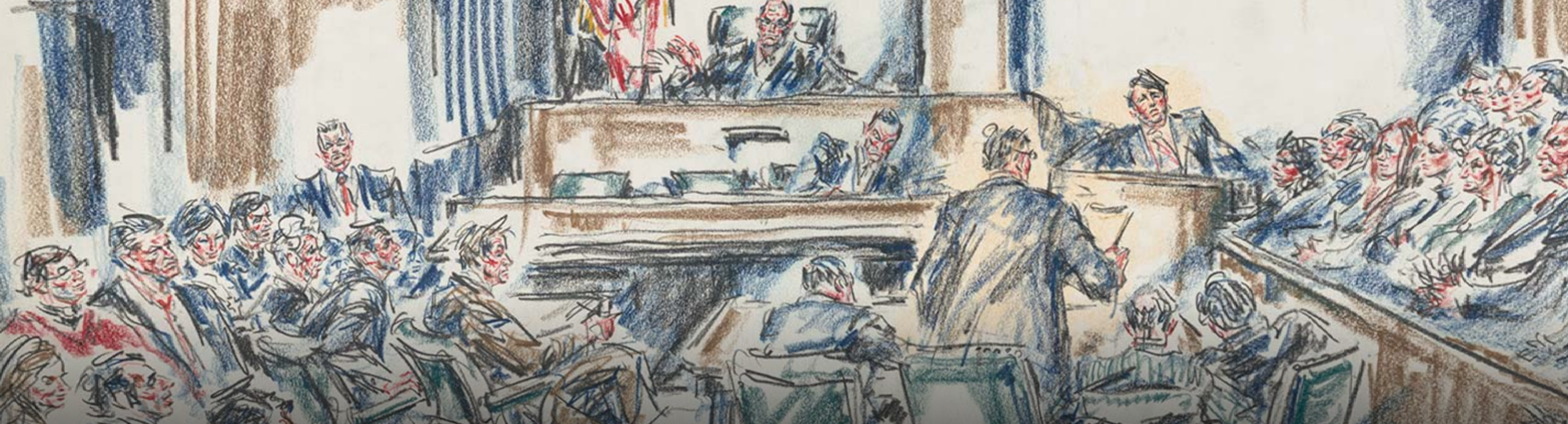
For decades, sketched courtroom drawings offered the public its only glimpse into closed high-profile legal cases. Today, becoming a courtroom artist is a unique path that blends artistic skill with a deep sensitivity to human emotion, storytelling, and the judicial system. At a time when cameras are restricted or outright banned in courtrooms, these artists play a crucial role in visually documenting legal proceedings for the public. Their sketches become the images people associate with closed high-profile trials, often capturing moments that would otherwise remain unseen.
At its core, courtroom art is about speed and perception. Trials can move quickly, and artists must be able to sketch with accuracy in real time, often working under pressure and without the opportunity for revisions. Unlike studio painting, there’s not the luxury of lengthy observations or multiple drafts. Good court artists have a developed awareness to instantly recognize and capture defining features, gestures and expressions, then quickly translate those unique observations onto paper with clarity and precision that convey a pivotal trial event.
Better Than a Brief, An Image Worth a Thousand Words
Courtroom artists have been documenting trials for centuries, with their origins traced back to the Salem Witch Trials of the 1690s. However, modern tradition and widespread demand for sketch artists wasn’t established until 1935 following a court media frenzy, which led the American Bar Association to ban cameras in all federal cases.
However, technical illustration on its own, is not enough. Courtroom artists must also understand the gravity of the setting they work within. They are often present during emotionally charged cases; criminal trials, sentencing hearings, or testimonies from victims and witnesses. Their objective is to remain focused at drawing, while composed, respectful and unobtrusive. The artist’s role is not to interpret or dramatize an image, but to document faithfully, while still conveying the emotional truth of the proceedings.
Breaking into this field typically involves a combination of artistic training, portfolio of work and journalistic awareness. Many courtroom artists have backgrounds in illustration, the fine arts or possibly graphic journalism. Building a collection of drawings that demonstrate quick sketch ability—especially of people in motion or candid settings, is key. Aspiring trail artists will often create a collection of works through practice at public locations such as cafés, transit stations or lectures, where they can sharpen observational skills and speed.
Networking also plays a significant role. Courtroom artists are often freelancers who work with news organizations or can also apply at a local courthouse. Establishing relationships with editors, producers, and legal correspondents will often open doors to new assignments. It also helps to stay informed about ongoing trials and legal news, as opportunity can often arise around high-profile cases.
Artistic Justice: In a Room of Deadpan Expressions

There are practical considerations as well. Courtroom artists must adapt to varying rules depending on judicial authority. Different courts or judges may prohibit specific tools and digital devices, while others may limit the time and where an artist can sit. Being flexible and prepared is part of the job.
Here are a few typical considerations when entering the rare space of a courtroom:
-
- Artists must rely on mediums that require little drying time and function with limited clutter.
- You are not allowed to capture jurors’ likeness or reactions during a trial.
- No distinguishing jury features are allowed, such as special clothing, glasses, unique hair color or expressions.
- To protect the juror identities, most artists will use a version of practiced people silhouettes for the group.
- Digitally sketched images on an iPad are ultimately allowed at the judge’s discretion.
- Apart from a judge’s ruling on electronic devices, the choice of medium is an artist’s call and usually range from pencil and pen to watercolor and markers.
- Cameras are typically forbidden to ‘preserve the dignity of the court’ and to help jurors avoid public recognition.
Despite the challenges, many artists find the work deeply meaningful. Trial drawings reside at the intersection of creative insights, journalism, and history. They don’t just illustrate an event, but also becomes a part of public record in capturing pivotal moments, intense exchanges and fleeting expressions, that at once shaped a legal outcome and the public’s perception.
For those interested in both art and real-world storytelling, becoming a courtroom artist offers a unique opportunity: to witness history as it unfolds and give it form through personal design.
-
- “It’s like walking a tightrope with no net. The better the drawing skill, the better and more informative the final illustration.” Tributes to Art Lien, courtroom artist
