

The Evolution of Revolution and The American Flag
July 1, 2026 / Helen Kachur
The history of the United States flag is a story of national evolution. Through 250 years, the design has changed to mirror the country’s growth, transformed from a basic wartime necessity into a powerful global emblem of national identity.
Revolutionary Roots (1775–1777)
The earliest American flags evolved from the chaos of the Revolutionary War. First a banner was used to gather Continental forces and raised to mark opposition to British Influence. One of the first American flag designs, combined the British Union Jack with 13 red and white stripes to represent the nascent colonies. After the Second Continental Congress statesmen sought a completely independent visual identity, at which time an official flag legislation was written on June 14, 1777. Its regulation mandated 13 stripes and 13 white stars on a blue field. Historians now dispute the popular Betsy Ross story, as evidence shows that a signer of the Declaration of Independence, Francis Hopkinson, actually designed the first official flag.
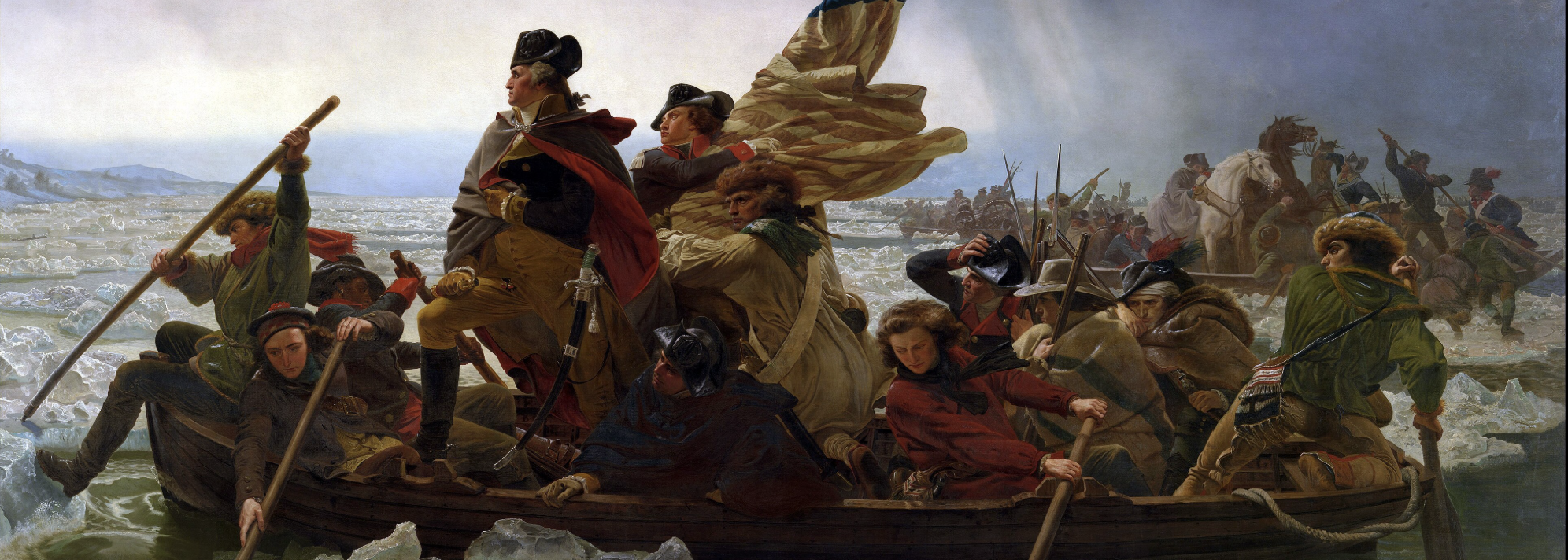
Likely the most popular heroic image of the American flag was painted by a German artist Emanuel Leutze, titled George Washington’s crossing of the Delaware River, 1851. It honors a critical turning point in the American colonists’ war against Great Britain, depicting Washington boldly leading his troops across the icy river on Christmas night in 1776. Look closely, the boat contains an inclusive, allegorical mix of American soldiers, including an African, a Scottish immigrant and Native Americans. The massive oil painting measures, 12ft x 21ft. Shortly after Leutze ‘s completion and the final brush stroke placed, his work was damaged by a studio fire, subsequently restored, then during World War II was destroyed again in a bombing raid. The second painting, a replica of the first, yet larger, was ordered in 1850 by a Parisian art trader, Adolphe Goupil for his New York office. It now hangs at the Metropolitan Museum of Art in New York and is considered their most visited display.
Serving Duty as a Standard-Bearer
For over two centuries, the Stars and Stripes have served as a potent canvas for the changing definitions of American identity. From early colonists, to its resource potential of the country’s vast lands and the current age of technology, the colors are by character emblematic.
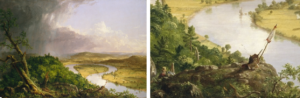
Artists reimagined the flag as it shifted to modern interpretations and critiques of society. 19th Century American painters treated the flag as a hallmark of unity, focused on nation-building milestones. In works by landscape artist Thomas Cole, subtle contrasts were made to show the potential of the natural American lands with the ordered, flag-bearing progress of civilization. However, at his painting, The Oxbow, the umbrella to the foreground is often mistaken for a flag.
Impressionism and Optimism
Childe Hassam (1859–1935), a leading American Impressionist famously documented New York City’s Fifth Avenue decorated with flags during World War I. His “Flag Series” included about 30 patriotic canvases created between 1916 and 1919, that captured the city’s home-front fervor, war-bond drives, and the military alliance between the US, Great Britain, and France. Hassam varied his viewpoints, capturing scenes from street level, slightly elevated from windows or looking directly up at the towering skyscrapers and vibrant, wind-tossed banners. His works also featured US flags hanging alongside that of Allied nations. During the Fourth Liberty Loan Drive in 1918, specific blocks of Fifth Avenue were dedicated to different countries, earning it the nickname “The Avenue of the Allies.”
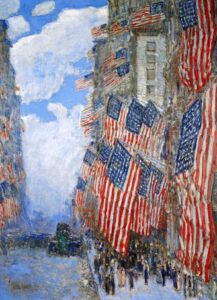
‘The Fourth of July, 1916 ‘
Deconstructed Flag
The post-WWII era transformed the flag from a symbol of national confidence to what we now consider as a physical object of artistic debate. As the nation crossed the threshold to industry and technology, the flag became a device of urban energy and collective pride.
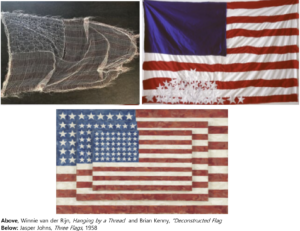
Modern interpretations of the American flag range from artist Brian Kenny, “Deconstructed Flag,” Jasper Johns’s iconic 1950s encaustic works, to a deeply meaningful textile piece created by artist Winnie van der Rijn, titled ‘Hanging by a Thread.’ Winnie’s design is a delicate process of sewing thread onto a soluble substrate, which is then dissolved to leave only the threadbare structure. It’s a fragile piece with unfinished edges; yet an elegant work that’s open to countless interpretations of past wars, fragile nature of a republic or the potential hope for a reconstructed future.
 _______________________________________________________________
The art of painting an American flag transcends basic patriotism by turning a rigid national symbol into a dynamic canvas of personal, social and political expression. Modern artists show that a flag is not just a national emblem, but a tactile object open to manipulation, texture and conceptual reinterpretation. By deconstructing its familiar geometric shapes and contrasting colors, these creators challenge viewers to look past the surface of identity and confront the changing history it represents. Today, flag art serves as a powerful visual mirror, reflecting both the unity and the deep contradictions of the human experience.
