

Washington DC’s Heroic New WWI Memorial, ‘A Soldier’s Journey’
May 21, 2026 / Helen Kachur
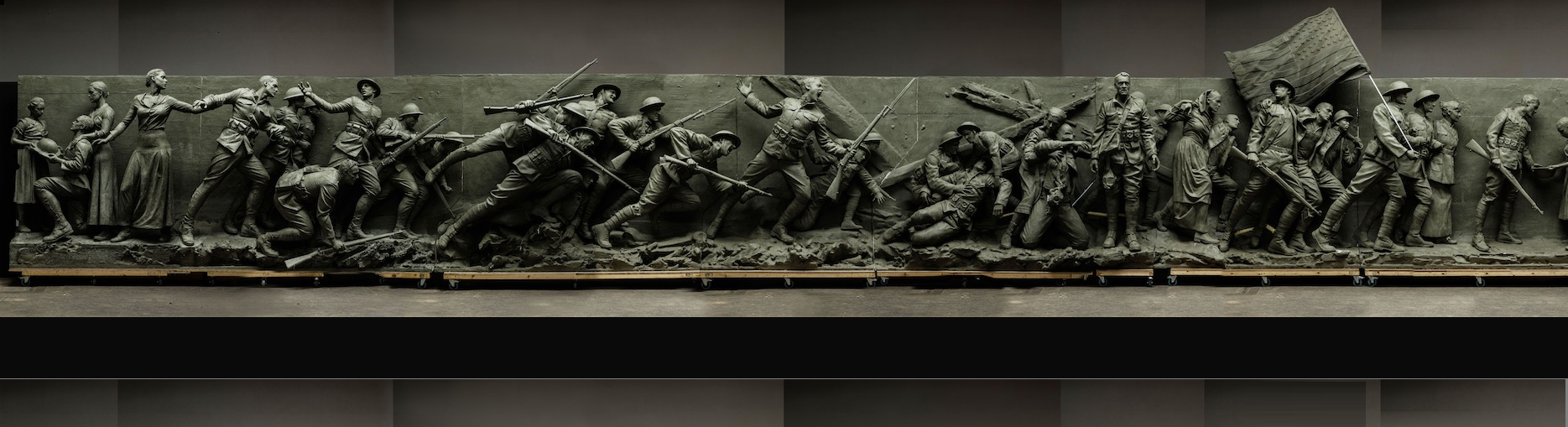
A dramatic high relief bronze monument titled, A Soldier’s Journey, by sculptor Sabin Howard commemorates the first World War One monument in Washington DC.
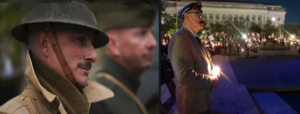
This week as evening falls on the busy streets of Washington DC, The WWI Centennial Commission and Doughboy Foundation will pay a Memorial Day tribute at the 58-foot-long bronze WWI statue presentation of thirty-eight individually carved figures. It’s the centerpiece of a newly renovated John Pershing Plaza and designed by sculptor Sabin Howard, who aptly titled his work, A Soldier’s Journey.
The huge bronze work’s theme is a presentation of opposites, contrasting a young girl to men physically engaged in war, and the customary stillness of a reflecting pool to the sculptor’s turbulent design of battle charging infantry. In an illuminated event of military fanfare, visitors are invited to gathered around the memorial to share in heartfelt reflections of remembrance, at the city’s first WWI monument, dedicated by Washington DC’s Department of Parks
An Intern-Architect’s Park Design
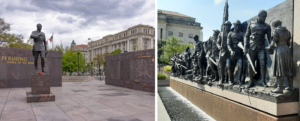
In the year 2015, the WWI Continental Commission award for a John Pershing Park renovation was notable by the selection of Joseph Weishaar. The Commission’s committee members took special interest in Weishaar’s design specification, that stipulated a traditional ‘figurative monument’ in lieu of modern conceptual art. Weishaar was a Chicago intern – not yet licensed architect, who at the age of twenty-five had little work experience. In support of his new design build, the architectural firm GWWO out of Baltimore was hired to oversee construction and land development. With all parties in agreement to the new site’s development, a collaborative of architects, artist and land developer worked towards a balanced project restoration of open court areas, fountain and statue centerpiece.
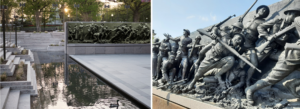
The design team’s site plan introduced new structural elements of two ten-foot engraved granite information walls and a belvedere for visitors to study and read over lower-level court walkways, stepped seating, sculpture and reflecting pools. Bermed earth with plantings, that now surround the court perimeter, act as effective sound barriers to busy pedestrian streets. Near the foliage boarder, but secluded to the back of the long bronze sculpture, stands the granite Peace Fountain. Its wall of gently falling water passes behind raised text excerpts of Archibald MacLeish’s poem, “The Young Dead Soldiers Do Not Speak,” which begins;
-
-
- “…They say, We were young. We have died. Remember us.
They say, We have done what we could but until it is finished it is not done…
They say, We have given our lives but until it is finished no one can know what our lives gave.
They say, Our deaths are not ours: they are yours: they will mean what you make them.”
- “…They say, We were young. We have died. Remember us.
-
Follow the Enlisted Guy
Sabin Howard described his WWI monument, A Soldier’s Journey, as a personal service dedicated to the military, but for the public. His initial project criterion, as defined by the WWI Commission prospectus, was a sobering task, ” … to design a memorial in tribute and honor of 4.7 million WWI service members, and over 116,000 who gave their lives.” Howard chose a concept to represent the whole, by distilling his design into just one man’s war experience. Displayed across a colossal 58-foot length bronze work he created 38 life-size figures, grouped into five unique panels of sequenced events.
Howard’s war memorial has since been met with much approval. It now stands through the day in elegant sculpted high-relief of figures that become animated by direct sunlight that cast shadows and movement across its long surface. His first panel features a civilian recruitment and swift departure to awaiting fellow infantry in the midst of battle. Following through the scenes, physical gestures and weary faces are filled with raw emotion, absent of heroic symbolism or embellishment. Howard’s narrative comes to an end in silent victory, as marked by a young girl who receives her father’s army combat helmet as a sign of formal discharge.
Through dramatic gestures and the the expressions of his bronze figures, Sabin Howard’s memorial acknowledges the severities of war, offering no resolution yet maintains ownership to the past. Each grouping of his carefully arranged figures, clearly define the emotional and physical toll of conflict; where lives were disrupted, men were lost, and many left homes without assurance or plan for safe return.
“Freedom is never more than one generation away from extinction.” – President Ronald Reagan
