All posts by Helen Kachur

En Plein Air Painting with Art Guide’s Travel Crew

Mammoth Hot Springs, Yellowstone National Park, 2025

This summer TheArtGuide.com travel team turned its attention to the grand vistas of American West, visiting art museums and galleries of cultural areas that were first colonized by Indian and Spanish settlers. Their social influence over the region encouraged years of unique American artwork that continue in the practices of local art communities.

    • “Everything that is painted directly and on the spot has always a strength, a power, a vivacity of touch which one cannot recover in the studio… three strokes of a brush in front of nature are worth more than two days of work at the easel.Eugene Boudin

Historically, ‘en plein air,’ in the open air, painting dates back to British artist John Constable (1776-1837), who was the first to store pre-mixed paint in pigs’ bladders for field work. On location, he’d set up a large blank “six-footer” canvas that no doubt acted like a kite in windy conditions. Shortly later, in 1841 this practice was improved upon by the advent of metal paint tubes that made oil paint a more versatile medium and freed landscape artists for work directly in nature.

Though Constable never left England, a French art dealer John Arrowsmith submitted three of his landscape works to the 1824 Paris Art Salon. Constable’s painting “The Hay Wain” was singled out for a prominent gold medal, awarded by King Charles X of France. Recognized by professional artists of the time, his work was an innovation in showing realistic weather conditions and latent atmosphere between distant objects. Constable’s outdoor painting technique echoed throughout French art. It inspired the Barbizon School of Art and encouraged others to take on potentially adverse weather in an experimental art genre that inspires artists to this day.

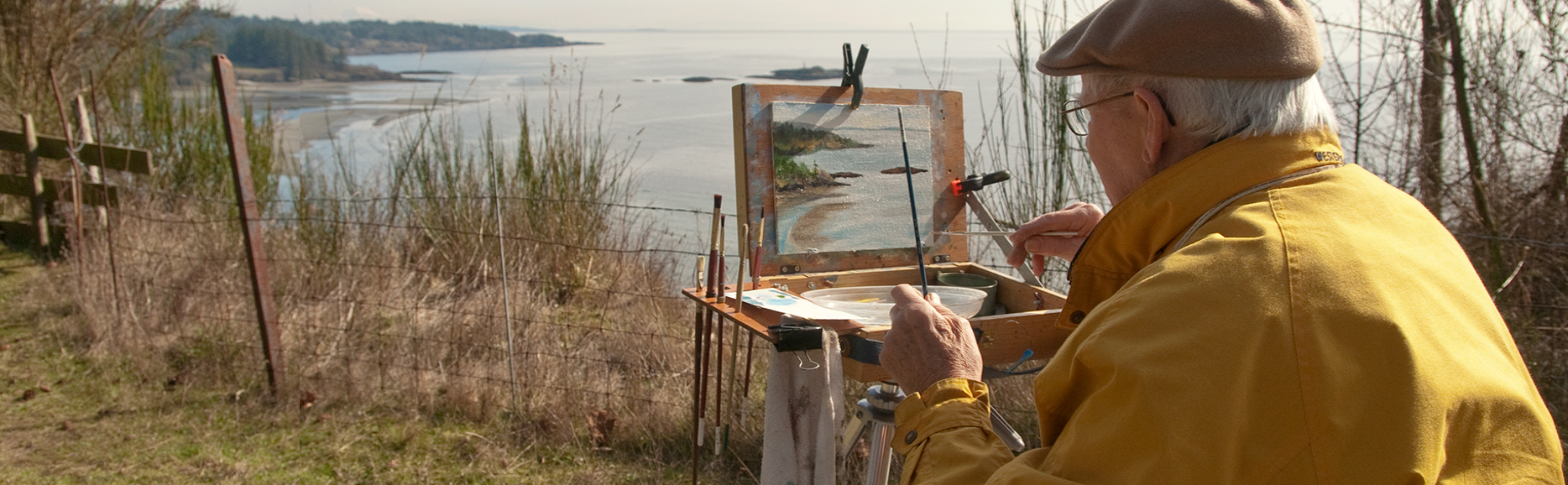
Following in Constable’s noble tradition, the Art Guide travel team found that painting on location is a challenge which offered the reward of time spent in nature among likeminded artists. During the months of fall, we’d like to encourage our readers to leave the comfort of a studio for the unpredictable experience of working outside. To help plan your excursion, Art Guide offers suggestions from preparing a color palette to testing different landscape compositions.

             80/20 Pareto Painting Principle

In art, the 80/20 rule suggests that 80% of results come from 20% of our final efforts, manifested as a principle for improving painting efficiency during a brief practice session outside.

Our team’s best plan for initiating an outdoor painting project is to reduce a vast scenery of options to one basic composition, which is not always easy. At the start of a painting, they recommend maintaining a focused subject, and keep materials simple. Purchasing a variety of modern-day art equipment is costly and once in the field, often ignored in lieu of a basic compact watercolor kit with paper block. Reliable studio supplies are also a great help to avoid equipment distractions.

Thumbnail Sketches help to focus a visual scenic expanse into a few brief line gestures and isolate key compositional elements. At this stage, it’s important to envision perspective and layout by drawing a series of small vignettes for a final selection.

With a sketchbook and a soft grade pencils in hand, it’s a good idea to walk about an area to find inspiration. It will happen by gathering a few visual ques. Do hesitate, do stop, and then, do move on. At this point there is no commitment only pictural notes.  Use the time to also move objects about your picture plain and collect a diary of information that won’t be lost to a new bit of scenery at the next turn in your path. Sketched notes are a vital field reference and should include a range of directional pencil marks, that can later resemble brush strokes differentiating textures, such as a grassy wheat field vs water or a jagged rock face.

    • “With all the changing atmosphere and clouds, light and everything, you basically have to stick to your original idea. It’s very challenging at times.” Clyde Aspevig


                Shapes and Shadow Shifters

By using large brush movements and working an entire paint surface, field drawings can act as a map for design transfer to canvas. First, block in key elements, while mindful of composition and eye movement from foreground to diffused background objects. Avoid painting hard edges or getting tied to any detail at this early stage. Once complete, define compositional objects as tonal values. Light and dark areas will solidify and create balance across the final canvas.

Remember to be mindful of all the shadows! Good shadow placement validates a landscape and adds depth to a scene. However, in an instant the sun’s movement can change landscape colors and shadow direction. Work quickly, commit to shadow length and direction, then ignore the sun’s persistence to rearrange your initial design plan.

  Least Significant Were the Actual Land Objects

Winslow Homer once visited Monet in Giverny to find, “Monet pulled out his latest series, views, at differing hours and weather, of the river, announcing the full significance of summer, sun, heat, and quiet on the reedy shore. The pictures were flowing in treatment; pointillism was in suspension; at least were the subjects.” A visit with Claude Monet, from the diary of Cecilia Beaux. –  It’s interesting to note the least significant were actual land objects, in lieu of atmosphere.

                                                                                                      More travel stories next week…