

Tales of Trails and Early Photographic Adventures
January 10, 2026 / Helen Kachur
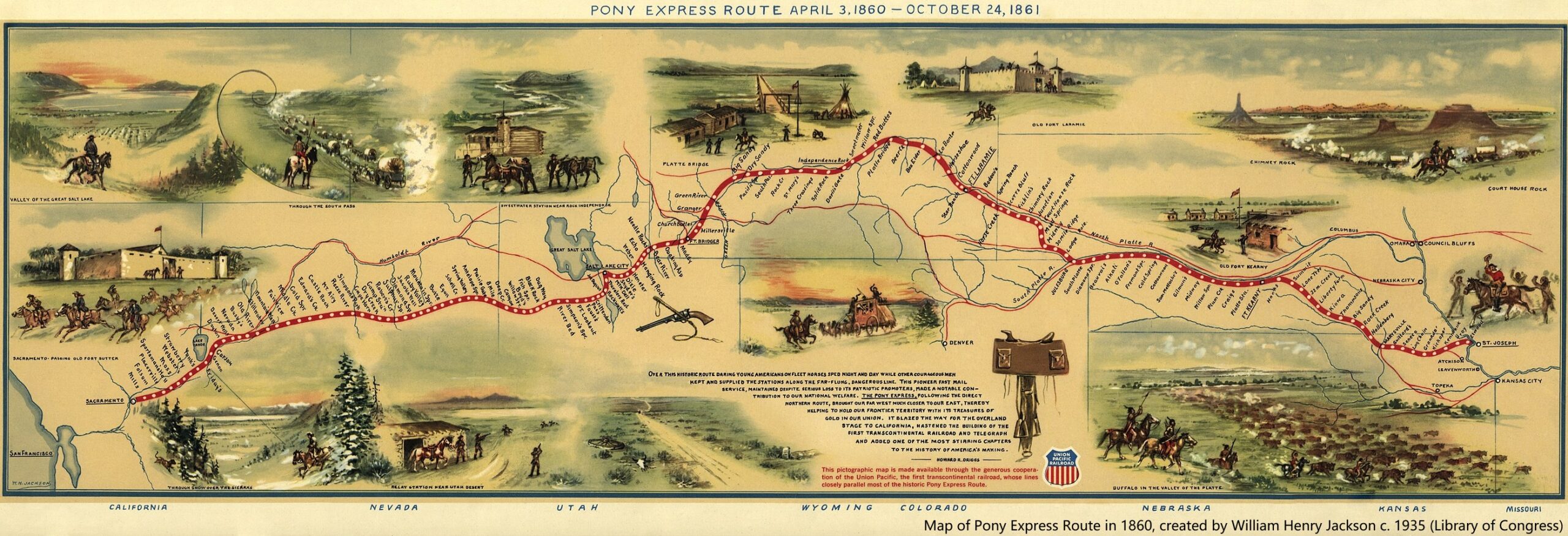
William Henry Jackson (1843- 1942), frontier photographer of the American western landscape, was a Civil War veteran, painter and explorer. In a fitting way, this celebrated American artist’s great-uncle, Samuel Wilson, was the model for our Nation’s iconic symbol of Uncle Sam.
-
- They were chased by Indians, their mules shot. And run they did – often leaving behind valuable scientific equipment and ‘vittles.’
From youth, Jackson was a skillful artist and by the age of nineteen illustrated images of pre-Civil War events. However, it was his photography of the Western Territories that brought him national acclaim. Known as the Country’s “pioneer photographer,” he left his home in Vermont to travel by train to Montana where Jackson worked as a bullwhacker, a 19th century driver of freight and oxen along the Oregon Trial. During these rugged adventures, he continued to sketch and eventually took the first photo images of Mesa Verde cliff dwellings, Colorado Mount of the Holy Cross and natural wonders of Yellowstone.

At the age of twenty-six Jackson returned east to Cleveland where he met with Dr. Ferdinand Hayden, director of the U.S. Geological Survey for Western Territories, who offered him an ‘unpaid’ position as the official expedition photographer. Jackson accepted the task and began to procure equipment to photograph US railroad expansion and the vast landscapes.
At the time, stories of the Dakotas, Montana and Wyoming were limited to accounts of exaggerated folklore by mountain men and trappers. Through federal appropriation and congressional oversight, Hayden’s expedition was to provide scientific evidence of western horticulture, geological samples, artifacts, inhabitant activity and mapping; all well documented through the lens of Jackson’s camera.
It’s difficult for us to now imagine that the majority of 19th century Washington lawmakers had no concept of the entirety of land that they governed. Easterners knew about California’s rugged coastline and growing population, that by 1869 was reached via transcontinental railroad. However, the northern interior states of the Dakotas, Montana and Wyoming were left fully uncharted. Fueled by explores’ curiosity and hope for potential natural resources, the Hayden Expedition gathered a notable team of geologists, cartographers, horticulturalist, botanists and entomologist to provide valid scientific research of the unexplored lands.

-
-
- In legacy, William Jackson’s artful photographic images encouraged the first national parks environmental protection programs to the benefit of all future generations.
-
During travel the survey team contended with a variety of issues including, dangerous wildlife, grizzly bears, travel fatigue, thin air at high elevations and dry summers that quickly led to early fall snows. They were chased by Indians. And run they did. Their mules were shot and supplies lost, often leaving behind valuable scientific equipment and ‘vittles.’ Consider also, the enormous load of photographic gear used in the mid 1800’s. Mules carried oversized cameras necessary to capture large scenic vistas, which required tripods, process chemicals, water kegs and many hundreds of heavy glass plates. At the time, fragile glass plates served as negative master prints. They were curried from location back to DC and then used to produce paper photo copies. Jackson noted in his book, Time Exposure that, “The whole of equipment must have weighted no less than 300 pounds… and it normally took half an hour to capture one image.”
Dr. Ferdinand Hayden‘s first Yellowstone regional survey ended in 1871, when the team returned to Washington DC to present their findings and campaign for the protection of America’s western wilderness. To persuade congressmen of the importance of land preservation, Jackson provided each member a collection of scenic photos. Weakly perceived amid the clamorous pace of everyday Washington DC, lawmakers were briefly silenced and became more receptive by seeing the unhidden grand vistas in black/ white images. Within just weeks the Yellowstone Park Act landmarked regions of Montana and Wyoming for future benefit to the public; preventing development and mandated land conservation. Between the years to follow, from 1870 to 1878, photographer William Jackson continued to work with the U.S. Geological Survey of Western Territories participating in a total of nine expeditions .
… more art travel notes next week!